
Natural Disaster Risk Profile
Insurance Center Associates
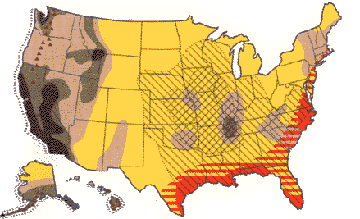
Disasters can strike at any time. The map below will provide you with information about the types of the natural disasters prone to your region. To guard against a particular disaster, take a look at Natural Disaster Tips.
Protect Yourself and Your Family from Disasters
Get a Free Insurance Quote
Natural disasters are becoming more frequent
Leading meteorologists, such as Dr. William Gray (University of Colorado) who accurately forecast Hurricane Andrew, predict a sharp rise in the number and severity of hurricanes in the near future as part of a 30-50 year cycle of hurricane activity.
There is an 86 percent chance of a catastrophic (magnitude 7 or stronger) earthquake occurring in California within 20 years, according to a January 1995 report by the scientists at the University of California.
The probability of a major earthquake occurring in the eastern United States before the year 2000 is better than 75 percent and nearly 100 percent before the year 2010, according to the National Center for Earthquake Engineering Research.

Natural disasters are becoming more costly
Prior to 1987, the United States never experienced a natural disaster with insured losses greater than $1 billion. Since that time there have been eight such events.
New studies project higher losses from future storms: $53 billion for a class 5 hurricane striking Miami and $51 billion for a class 4 storm striking New Jersey and Long Island.
A catastrophic earthquake striking Los Angeles or San Francisco, or a similar quake in the New Madrid Zone of the Mississippi River Valley, could cause insured damage of $100 billion.
The enormous potential for future losses is causing insurance availability problems.
A.M. Best, the independent insurance rating service, recently announced it will lower the financial ratings of at least 14 major insurers if they do not reduce their exposure to natural disasters.
Approximately 40 percent of all homeowners in Hawaii lost their insurance after Hurricane Iniki due to insurer insolvency and market withdrawals.
The probable maximum loss from a hurricane striking Honolulu is $30 billion – the equivalent of 483 times the annual homeowners insurance premiums collected in the state ($62 million).
Only 1 in 5 California homeowners carry earthquake insurance; in other parts of the country where earthquakes are also a risk, the rate is less than five percent.
Proper planning could save lives and substantially reduce property loss.
Many states and localities have not adopted building codes which will reduce damage caused by wind, flood and earthquakes – and where codes are in place, they are not always properly enforced.
In the aftermath of Hurricane Andrew, experts found that losses could have been reduced by as much as 30-40 percent had existing building codes been properly enforced.
The United States spends less than $4 million annually on wind-hazard mitigation, most of which is for storm-warning capability. Given recent windstorm devastation, it is clear that a greater investment in prevention could reduce disaster losses by hundreds of millions of dollars.
Information provided courtesy of Independent Insurance Agents of America